
In Harmony
The Singing City Blog
Program Note: Liberty and Justice for All by Sharon Chestnut
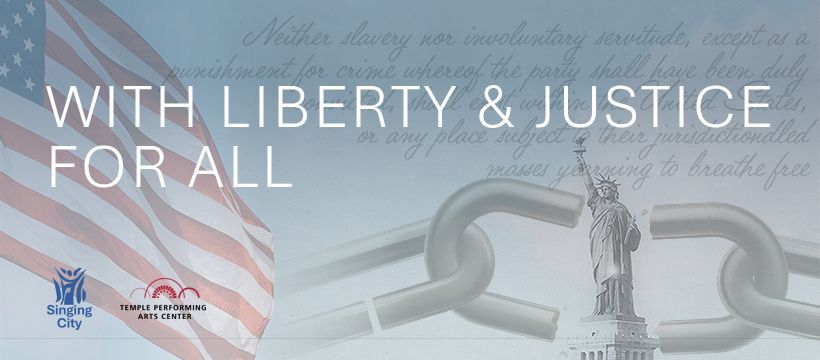
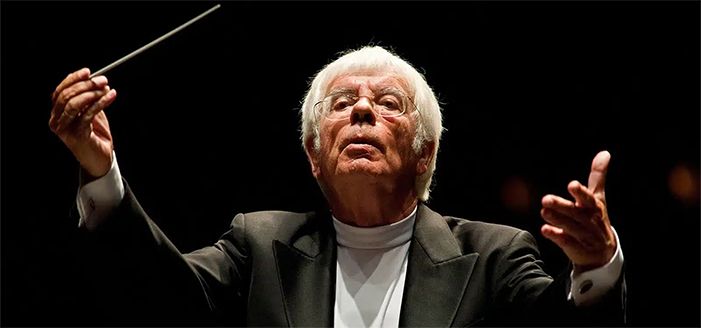
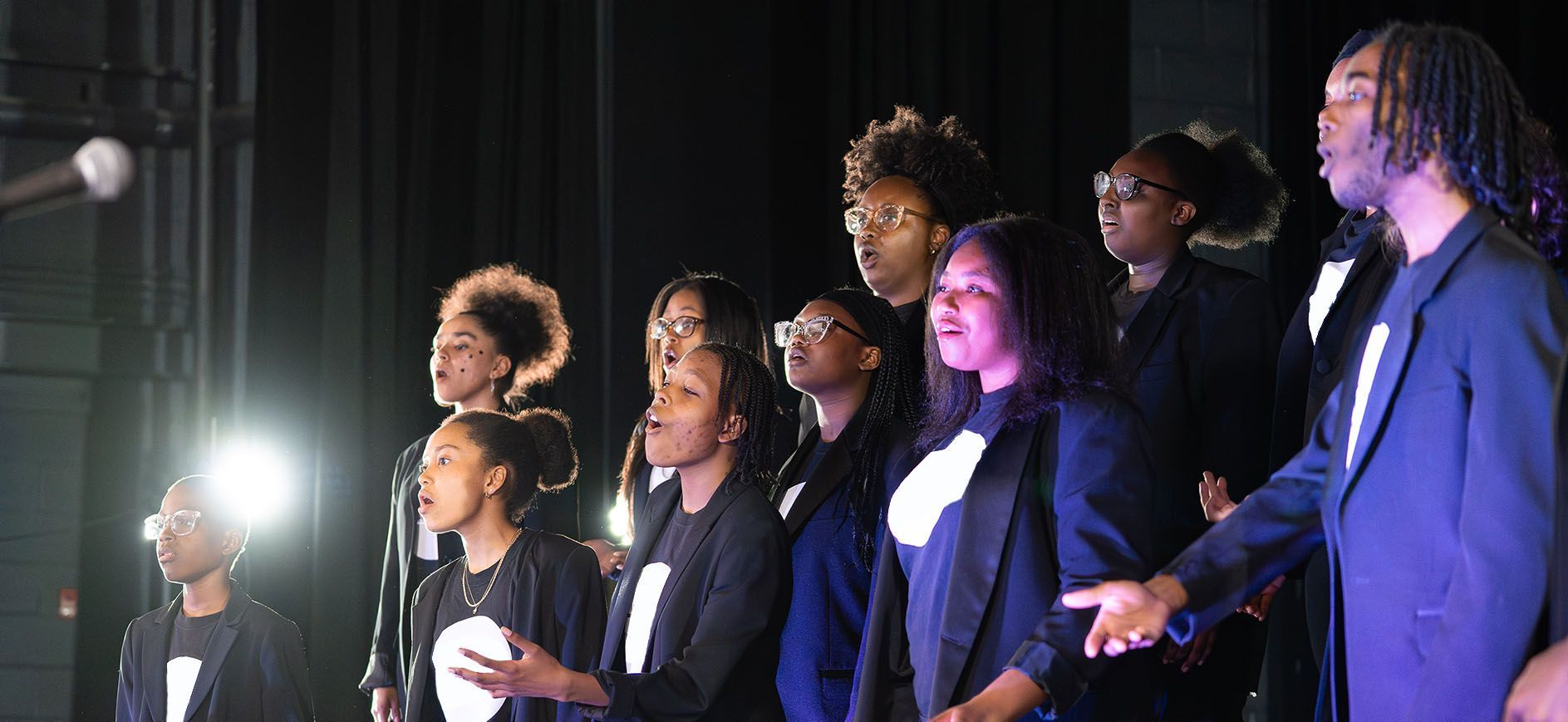
As Singing City brings its season to a close, we invite you to join us for our final concert, With Liberty and Justice for All, on May 3 at 3:00 p.m. at the Temple Performing Arts Center. Led by Artistic & Music Director Rollo Dilworth and featuring more than 100 voices, the program is anchored by a powerful performance of Damien Geter’s 1619, weaving together music, text, and multimedia to examine the promises and complexities of liberty and justice in America. In preparation for the concert, we invite you to explore the program notes below by S. Chestnut.
Click here for tickets and information.
“Those who would give up essential Liberty, to purchase a little temporary safety, deserve neither Liberty nor Safety”
— from Benjamin Franklin’s 1755 letter on behalf of the Pennsylvania Assembly during a wartime tax dispute over defense.
This aphorism traces to Benjamin Franklin’s final attempt to negotiate colonial grievances as subjects of the Crown. It offers insight into the “American” disposition, predicting that if royal mandates continued to ignore the liberties required within any “just” practice of government, colonists would eventually choose to “suffer all the hazards and mischiefs of war” rather than surrender those rights.
Franklin’s warning proved prophetic. War did ensue. And yet this intrinsic aspect of the American character re-emerged, undiluted, a few years later in the thick of the conflict:
“With European soldiers, I say ‘do’ and they do. With American soldiers, I must first tell them why they do, and only then do they obey.” — Baron Friedrich Wilhelm von Steuben, training attaché to George Washington, 1778
Baron Friedrich Wilhelm von Steuben was a minor Prussian aristocrat (who spoke no English), imported to equip untrained citizens against a professional military. During his tenure, the encampment at Valley Forge saw many soldiers in rags, defenseless against the awful winter. Unshod, bloody footprints marked the snowy parade ground. And yet, with strict military discipline the only way forward, obedience was not a given. Their sense of rebellion was as visceral as frostbite. Huddled, mustered sufferers understood that their fight required vigilant, on-the-spot assessment of all imperatives, regardless of immediate benefit.
Such was the founding population that transitioned itself from a defiant colony to a nation-state that claims liberty and justice as its pledge and aegis.
However, the proper balancing of sovereignty and liberty, justice and comfort, remains a challenge.
Our concert offers a path through this dilemma, organized into four categories for reflection:
1) Sobriety and Humility
We begin with Ysaÿe Bramwell’s cautionary hymn “Spiritual,” which reminds us how precious and precarious any day’s journey might be. Though written in a minor key, it is not designed for sadness, but to invoke sober resistance to arrogance and presumptions of personal or cultural longevity.
These themes re-emerge throughout, within Randall Thompson’s “God Who Gave Us Life” and Margaret Bonds’ “I Believe in the Prince of Peace,” cautioning us to choose those who embody grace, not force, as leaders.
Toward Justice (Medema & Chamblee) literally floats the nature of justice amid elegiac melody and lyrics, using lines from the Rev. Dr. Martin Luther King, Jr. and the Beatitudes to define the concept as elemental, environmental, and eternal; intrinsic to both the human soul and history. This gentle thematic use of water stands in stark contrast to other program imagery, which references Middle Passage horizons and collapsed municipal “irrigation” as markers of flagrant injustice.
2) Public Penance
The centrality of enslavement to the question of American democracy is demonstrated in this quote offered by Abraham Lincoln during a series of debates that laid the groundwork for his successful presidential campaign in 1860. He frames the issue as more than an exercise in “popular sovereignty,” but as a universal touchpoint central to all considerations of justice.
“It is the eternal struggle between two principles, right and wrong, throughout the world. It is the same spirit that says, ‘You toil and work and earn bread, and I’ll eat it.’ No matter in what shape it comes… it is the same tyrannical principle.”
— Lincoln-Douglas debates, October 15, 1858
To this end, Singing City offers Damien Geter’s 1619 as the centerpiece of our program, outlining the dynamics of capture and enslavement through first-hand accounts of Africans. The composer “walks” us from West African shorelines, where vibrant people(s) were lured from curiosity to trust and then kidnapped. The work culminates in a stark account of pernicious social outcomes that persist to this day, allowing select humans to preempt the lives and livelihoods of others.
Dim stuff, but surprisingly, Geter’s score rejects a minor-key perspective on the matter. This is most strikingly demonstrated in the melodically sprightly third movement, “Dance.” It offers a detailed first-generation narrative naming two family predecessors, Goerge and Nellie, who transferred memories of their origins to offspring. Chronicling craven deception, a startling awakening amidship, irreversible abduction “with water all around,” Dance offers an intimate portrait of a transition from homeland life, where protection and privilege were birthrights, to culture which ripped liberty and justice from their very identities. offering an intimate portrait of a transition from homeland life, where protection and privilege were birthrights, to a culture that stripped liberty and justice from their very identities.
An excerpt from the Justice Choir Songbook songbook closes out this half of the program with Elizabeth Alexander’s “This is What Democracy Looks Like” raising a retort to those outcomes.
3) Raising Resolve
Snappy retorts flash through the program. The second half opens with “Water Fountain” (Brenner and Garbus), which sets an incisive map of social compromise within a deceptively engaging format.
“United in Purpose,” “Song of the Revolution,” and “Let Peace and Justice Lead the Way” (Dilworth) expand on this theme, simultaneously supplying energy for the struggle.
4) Common Ground
First Nations people aside, most of us can trace our presence on the North American continent to some program of immigration. Remembering the intimate details of those transitions is crucial to a balanced understanding of liberty and justice. Those migrations hold the record from which we must discern consequences and correct history’s missteps.
Irvin Berlin’s beloved setting of the Emma Lazarus poem, “Give Me Your Tired, Your Poor,” gives a very gentle view of American largesse. And yet that invitation to immigrants has been redrafted, compromised, and withdrawn at crucial moments. Especially when new presences seem poised to overwhelm “native born” comfort and cultural primacy.
It is therefore fitting to conclude our concert with two works written in languages that most of us neither speak nor understand but attest the universality and fragility of our founding principles. Each work embraces questionable arrival history as birthright and springboard for new relationships. It is crucial that these musing are offered raw; this transports mainstream speakers to that moment when our own forebearers arrived as aliens, harboring strange tongues and hoping for future.
Translation proves the universality of the project. Both Tracy Wong’s “Bersatu Senada”(Together with Voice), and Dyan Tran’s “Luôn Luôn” (Always) signal us to listen with unprivileged ears as others declare the universality of creeds which we have called our own.
Justice and Liberty are always a tricky pairing. Less sanguine drives are always poised to redistribute freedom to the advantage of (s)elect few. When anyone is excluded from the basic considerations of civility, fault lines erupt into bloody civil conflicts. Casualties pile in familiar patterns around us.
We’ve seen this again and again. And yet history has endowed our nation with an extraordinary identity, a tenacious capacity for uplift, and an audacity to test ideals that are just as unproven as constitutional democracy was to this nation’s founders.
Whether a reviled religious sect, seeking a new landscape to practice, whether native peoples pressing to retain their footprints on land walked for eons by their ancestors, whether those fleeing from tribal conflict, tyrants starvation and brutal renditions of various kinds, we all sojourn in pursuit of liberty and peace which provisions our wellbeing and offers participation in life’s best offerings.
It is that legacy which we deserve to celebrate 250 years later. It is a challenge we should be proud to embrace.
Again, Abraham Lincoln said it well.
“Fellow citizens, we cannot escape history. ...The dogmas of the quiet past are inadequate to the stormy present. The occasion is piled high with difficulty, and we must rise with the occasion. As our case is new, so we must think anew and act anew. We must disenthrall ourselves and then we shall save our country.
— (excerpted from Lincoln’s Annual Message to Congress, December 1, 1862)